

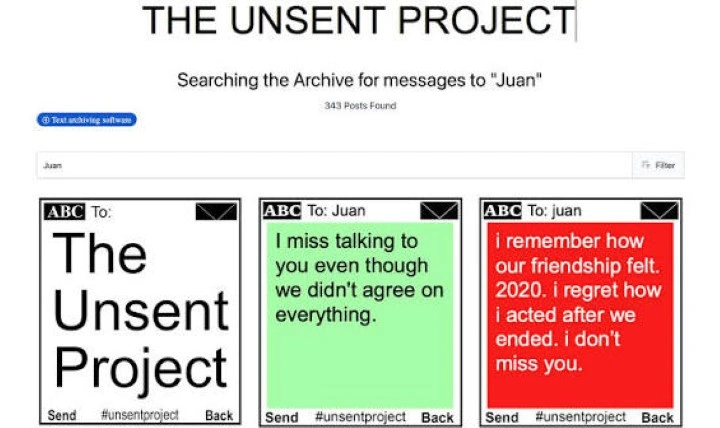
Some messages are written but never delivered. Some apologies remain unfinished. And sometimes, the words we want to say most are the ones we keep to ourselves.
The Unsent Project archive brings these hidden emotions into the open through anonymous messages about love, heartbreak, friendship, regret and the people we never quite forget.
Whether you’re searching for a familiar name, revisiting memories of a first love, or simply wondering what strangers wish they had said, an archive of unsent messages offers a fascinating look at the emotions people leave unspoken.
But how does the archive work? Can you search for messages addressed to your name? And is it possible to discover who wrote a particular message?
This guide explains how to explore the collection, understand its emotional themes, and make sense of the stories behind the words.
What Is the Unsent Project Archive?
An unsent messages archive is a digital collection of words that people wanted to share with someone but never delivered directly.
Messages may be written for former partners, first loves, childhood friends, family members or people who unexpectedly became important.
Some messages are only a few words long. Others describe years of memories, unanswered questions or feelings that never found the right moment to be expressed.
The concept became widely recognised through artist Rora Blue’s original Unsent Project, which began in 2015 as an artistic exploration of messages people never sent to their first loves.
Over time, unsent-message collections have inspired conversations about memory, emotional expression and the ways people communicate online.
TheUnsentProject.uk is an independent website, not the original project, and is not affiliated with or endorsed by Rora Blue or TheUnsentProject.com. It hosts its own collection of anonymous messages.
The appeal is simple: you can read something written by a stranger and recognise a feeling you have never been able to put into words.
How to Search the Unsent Project Archive
If you want to explore anonymous messages, you can use the search feature available on TheUnsentProject.uk.
Step 1: Open the Website
Visit TheUnsentProject.uk.
On the homepage, you will find a collection of messages addressed to different people.
Step 2: Find the Search Field
Look for the search box labelled Search unsent messages.
This is where you can enter a name or another search term to explore matching entries.
Step 3: Enter a Name
Try searching for a first name, nickname or another term associated with the message you want to find.
For example, you might search for a name you recognise or a person you have been thinking about.
Remember that many people share the same name, so a matching result does not necessarily have any connection to you.
Step 4: Select Search
Click the Search button to view matching messages.
Read the results carefully rather than assuming that every entry refers to a particular individual.
Step 5: Clear the Search
When you want to browse again without the current search, use the Clear filter option.
You can then try another name or return to exploring the broader collection.
Important: The search feature only helps you explore messages available on this website. It does not provide access to private text messages, deleted conversations or archives hosted by other websites.
Can You Search Unsent Messages by Name?
Yes. The search feature on TheUnsentProject.uk allows visitors to look for matching entries using a name.
However, searching for a name and identifying the person behind a message are two completely different things.
Imagine that you search for the name “Alex” and discover a message that says:
“I still remember the last time we spoke. I wish I had told you that you mattered more than you knew.”
You might recognise the feeling or wonder whether the message is connected to someone you know.
But without reliable identifying information, there is no way to establish that the message was written about you.
Why a Name Match Is Not Proof
There are several reasons to be cautious:
- Common names: Many people have identical first names.
- Anonymous authors: A message may not identify its writer.
- Missing context: Short messages rarely explain an entire relationship.
- Similar experiences: Heartbreak, longing and regret are common human experiences.
The value of reading an anonymous message is not necessarily finding out who wrote it. Sometimes it is simply recognising an emotion that feels familiar.
What Types of Messages Can You Find?
Unsent-message archives bring together a wide range of emotional experiences.
1. Unsent Messages to an Ex
Relationships do not always end when our feelings do.
After a breakup, people may continue to think about the routines they shared, the conversations they never finished and the future they once imagined together.
An unsent message to an ex might express sadness, appreciation, anger or a desire for closure.
Original example:
“I stopped waiting for your message a long time ago. But sometimes, when something wonderful happens, you’re still the first person I think about telling.”
These messages capture the complicated reality of missing someone without necessarily wanting to reconnect.
2. Unsent Letters to a First Love
First love often occupies a special place in memory.
It may remind us of discovering affection for the first time, learning to trust another person or experiencing an emotional goodbye before we knew how to handle it.
People sometimes write unsent letters to their first love because the relationship represents an important chapter of their personal history.
Original example:
“I don’t know who you have become, and perhaps you wouldn’t recognise who I am now. But I’m grateful we met when we did.”
Not every letter about a first love is a request for another chance. Some are simply expressions of gratitude or nostalgia.
3. Unsent Messages to Someone You Still Love
Sometimes feelings remain unspoken because the writer fears rejection, wants to preserve a friendship or believes that expressing those feelings could make an existing situation more complicated.
Original example:
“You probably think our conversations are ordinary. You don’t know how many times they’ve made an otherwise difficult day feel lighter.”
Messages like these reveal the difference between what someone experiences privately and what they are willing to communicate.
4. Unsent Apologies
An apology is not always possible.
Perhaps the other person has moved away, ended contact or made it clear they do not want to reconnect.
Writing an unsent apology can give someone a chance to acknowledge their own mistakes without demanding another person’s attention.
Original example:
“I understand now that being right wasn’t worth making you feel unheard. I’m sorry it took losing our friendship for me to understand that.”
An apology written privately does not undo harm, but it can provide space for reflection and accountability.
5. Unsent Messages to Old Friends
Not every important goodbye comes from a romantic relationship.
Friendships can fade through distance, changing priorities, misunderstandings or major life events.
An unsent message to an old friend might express gratitude for the friendship rather than frustration about its ending.
Original example:
“I saw something today that would have made us laugh for hours. For a moment, I forgot we don’t talk anymore.”
These messages remind us that friendship loss can leave its own form of unfinished conversation.
Why Do People Write Messages They Never Send?
Writing an unsent message allows someone to express thoughts without immediately involving the intended recipient.
There are many reasons a person might choose this approach.
Fear of Rejection
Admitting affection or regret can feel emotionally risky.
People may worry that a direct message will be ignored, misunderstood or rejected.
Writing privately offers a way to acknowledge the feeling without expecting a response.
Respecting Boundaries
Sometimes contacting another person is not appropriate.
The other person may have asked for distance, started a new relationship or chosen to end communication.
An unsent message allows the writer to reflect without crossing that boundary.
Remembering Important Moments
People often associate relationships with small memories: a favourite song, a familiar street, a particular season or a conversation that seemed insignificant at the time.
Writing about those memories can preserve their meaning without attempting to recreate the past.
Understanding Complicated Emotions
It is possible to feel sadness and relief, affection and anger, or nostalgia and acceptance at the same time.
Writing can help some people organise these conflicting emotions.
However, it does not guarantee emotional relief. If writing leads to repeated distress or rumination, taking a break or speaking with someone supportive may be more helpful.
Why the Unsent Project Archive Connects With So Many People
One of the most interesting things about anonymous messages is how personal experiences can still feel universal.
A message written by a stranger might describe a situation you have experienced yourself.
Perhaps it reminds you of a friendship that ended without explanation. Maybe it reflects the uncertainty of caring about someone who never knew how you felt.
There is also something distinctive about the format.
Unlike a carefully edited social media post, an unsent message may be brief, incomplete or emotionally contradictory.
A person might express love and disappointment in the same sentence.
Another might write only a few words:
“I hope you found what you were looking for.”
The absence of a detailed backstory leaves space for readers to interpret the message through their own experiences.
That does not mean every message represents a universal truth. It means anonymous expression can create moments of recognition between people who have never met.
The Meaning of Colours in Unsent Messages
Colour is closely associated with Rora Blue’s original Unsent Project.
In the original artistic concept, contributors selected colours connected to how they felt about their first love.
This made colour part of the artwork’s emotional expression.
People may personally associate blue with sadness, red with passion or green with hope, but these associations are not universal.
Two people can choose the same colour for entirely different reasons.
Rather than treating colours as a fixed emotional code, it is more useful to consider them as personal forms of expression.
If you want to explore the subject further, read our guide to The Unsent Project Colour Meanings.
Are Messages in the Archive Really Anonymous?
Anonymous messages may be displayed without publicly naming their authors.
However, anonymity should not be confused with an absolute guarantee of privacy.
A message might contain a unique memory, a location, an unusual nickname or another detail that makes someone recognisable.
In addition, the technical privacy protections of any submission website depend on its actual data-handling practices.
Before submitting a message, consider these precautions:
- Avoid sharing full names, addresses and phone numbers.
- Do not reveal another person’s private information.
- Think carefully before describing highly specific events.
- Read the website’s privacy policy and submission terms.
- Remember that published content may be copied or shared.
If you want your thoughts to remain entirely private, a personal journal or locally stored note may be a better choice than publishing online.
How to Write Your Own Unsent Message
You do not need to be a professional writer to express something meaningful.
Start with a person you have something to say to.
Then think about the one feeling or memory that matters most.
You might begin with:
- “I never told you that…”
- “The last time we spoke…”
- “I wish I had understood…”
- “I still remember when…”
- “If I could say one thing to you…”
Try to write naturally instead of worrying about finding perfect words.
For example:
“I used to think closure meant hearing an explanation from you. Now I think part of moving forward is accepting that some questions may never have answers.”
An unsent message does not need a dramatic ending. Sometimes a few honest sentences are enough.
You can keep your writing private or choose to share an appropriate version on a platform that accepts submissions.
How to Explore the Archive More Meaningfully
If you are new to browsing unsent messages, there are several ways to make the experience more thoughtful.
Start with curiosity rather than expectations. Searching for a familiar name can be tempting, but the results may not have any personal connection to you.
Read different emotional themes. Messages about gratitude and friendship can be just as meaningful as those about breakups.
Avoid guessing people’s identities. Anonymous messages rarely provide enough evidence to establish who wrote them.
Consider your emotional wellbeing. If certain messages bring back painful memories, you can stop browsing and return another time.
Use what you read as inspiration for reflection. A stranger’s message may help you identify feelings you want to explore privately.
The archive is most useful when approached as a collection of human experiences rather than a tool for uncovering someone’s private thoughts.
Frequently Asked Questions About the Unsent Project Archive
1. What is the Unsent Project archive?
It is a collection of messages people wanted to express but did not send directly to their intended recipients. The messages commonly explore love, heartbreak, friendship, regret and other personal experiences.
2. How do I search the Unsent Project archive?
Visit TheUnsentProject.uk, find the Search unsent messages field, enter a name or relevant term, and select Search to browse matching entries.
3. Can I find a message about myself?
You may find a message containing your name, but that does not prove it was written about you. Names and emotional experiences can be shared by many people.
4. Can I find out who wrote an anonymous message?
Not reliably from a message alone. Even if the contents seem familiar, it is best not to assume a particular person wrote it.
5. Is TheUnsentProject.uk the same as TheUnsentProject.com?
No. TheUnsentProject.uk is an independent website and is not affiliated with or endorsed by the original project associated with artist Rora Blue.
6. Can I submit an unsent message?
You can explore the submission options available on the website. Review the submission terms and privacy information before sharing personal content.
7. Are all messages about romantic relationships?
No. Unsent messages can also be about friendship, family, grief, gratitude, apologies or personal reflection.
8. Are unsent messages helpful for emotional healing?
Some people find expressive writing useful for reflecting on their experiences. Others may find it emotionally difficult. There is no guarantee that writing or reading unsent messages will provide closure.
Final Thoughts: Every Unsent Message Has a Story
The Unsent Project archive reflects an aspect of human connection that ordinary conversations rarely capture: the things people feel but choose not to say.
Behind a few lines of text might be years of friendship, a relationship that ended unexpectedly or a simple moment someone still remembers.
You may come across a message that makes you smile, one that leaves you thinking or another that reminds you of someone you once knew.
But perhaps the most important lesson is that not every feeling needs to become a conversation.
Sometimes the words themselves are enough.
Ready to explore?
Browse Unsent Messages on TheUnsentProject.uk
You might discover a story that feels familiar—or find the inspiration to write the words you have been keeping to yourself.

I loved as much as you will receive carried out right here.
The sketch is attractive, your authored material stylish.
nonetheless, you command get bought an edginess over that you wish be delivering the following.
unwell unquestionably come further formerly again as exactly the same nearly a lot often inside case you shield this increase.
Thank you so much for your kind words and feedback! We really appreciate your support. We’ll definitely keep improving and bringing you more valuable content. 😊