

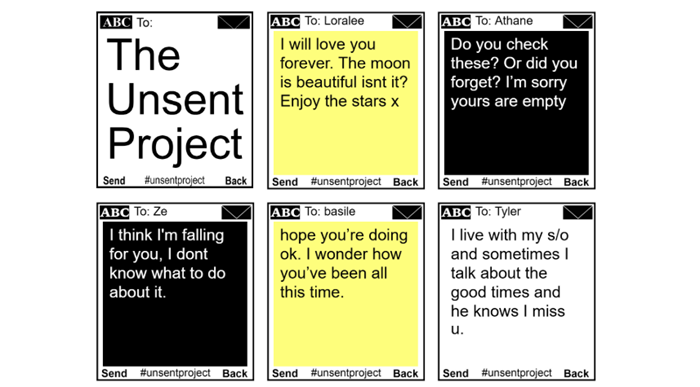
The Unsent Project has become a fascinating place for people who want to explore emotions that are difficult to express in real life.
At first, the idea seems simple. People write messages they never sent to someone important in their lives. Those messages may be about love, heartbreak, friendship, regret, missing someone, or simply something they were never brave enough to say.
But there is another part of The Unsent Project that makes the experience visually interesting: color.
When you look through different messages, you may notice that they appear in different colors. Naturally, this makes people curious.
Why is one message green while another is black?
Does yellow represent happiness?
Is red the color of love?
What does pink mean?
And is there an actual color chart that explains everything?
These questions are understandable because humans naturally connect colors with emotions. We see red and may think about passion. Blue can remind us of sadness or calmness. Yellow can feel cheerful and warm, while black may feel serious or heavy.
However, color meanings are not always as straightforward as a simple chart makes them appear.
The words themselves are still the most important part of an unsent message. A color can create a mood, but the message tells the actual story.
Let’s explore some of the most commonly searched color meanings and how they may relate to emotional messages.
Unsent Project Green Meaning
The unsent project green meaning is often associated with feelings such as growth, hope, renewal, jealousy, and emotional healing.
Green is an interesting color because it can represent completely different emotions depending on the situation.
Think about the feeling of starting over after heartbreak. You may still remember someone, but you are slowly learning how to live without them.
A message might say:
“I still remember you, but I am finally learning to choose myself.”
That kind of message can feel connected with green because it represents moving forward and growing from an experience.
Green is also commonly associated with jealousy.
Imagine someone writing:
“I told you I was happy for you, but honestly, seeing you with someone else hurt more than I expected.”
The same color can suddenly feel completely different.
This is why it is difficult to assign one permanent definition to green.
It can represent:
- Hope
- Growth
- Healing
- Renewal
- Jealousy
- Change
- Emotional recovery
For someone going through a difficult breakup, green might symbolize the beginning of a new chapter.
For someone dealing with jealousy, it could represent an emotion they have been trying to hide.
The context matters.
Unsent Project Black Meaning
The unsent project black meaning is often interpreted through emotions such as grief, sadness, seriousness, mystery, emotional distance, or the end of something.
Black is visually powerful.
It can make a message feel heavier before you even read the words.
Imagine seeing:
“I think this is the last time I will ever write your name.”
The sentence already feels emotional.
Placed against a dark background, the mood can become even more intense.
Black may naturally remind people of endings. It can symbolize the end of a relationship, the loss of someone, or the acceptance that something cannot be changed.
But black does not always have to mean sadness.
It can also represent strength.
Someone may write:
“I survived what I thought would destroy me.”
In that context, black could feel strong and confident rather than simply negative.
Black can also create a sense of mystery.
An anonymous message is already mysterious because you do not know who wrote it. A darker visual presentation can add to that feeling.
For this reason, it is better to think of black as a color that can create a serious, intense, mysterious, or reflective mood rather than assuming that every black message represents grief.
Unsent Project Yellow Meaning
The unsent project yellow meaning can be connected with happiness, warmth, optimism, friendship, hope, and positive memories.
Yellow is naturally bright.
It can remind people of sunshine, childhood memories, laughter, and moments that felt uncomplicated.
Imagine an unsent message saying:
“I hope you know how much happiness you brought into my life.”
That message feels naturally warm.
Yellow can also represent friendship.
Not every meaningful relationship is romantic. Sometimes the person we miss most is a friend who moved away, someone we lost touch with, or someone who was once a major part of our everyday life.
A message such as:
“I wish we could go back to those afternoons when we had nothing to worry about.”
could carry a strong sense of nostalgia.
Yellow may also represent hope.
After a difficult period, someone might write:
“Things are finally getting better, and I wish you could see where I am now.”
That is not a message of heartbreak.
It is a message about moving forward.
So yellow can evoke emotions such as:
- Happiness
- Warmth
- Friendship
- Optimism
- Hope
- Nostalgia
- Positive memories
Of course, personal experiences can change how someone sees the color.
A person who has a painful memory associated with yellow may interpret it completely differently.
Unsent Project Color Chart
If you are searching for an unsent project color chart, you will probably find different interpretations online.
The important thing to understand is that a color chart should be treated as a general emotional guide, not a strict dictionary.
Here is a simple way to understand common emotional associations:
| Color | Common Emotional Associations |
| Red | Love, passion, desire, anger, intensity |
| Blue | Sadness, calmness, loneliness, reflection |
| Pink | Affection, tenderness, romance, sweetness |
| Purple | Mystery, depth, nostalgia, complicated emotions |
| Green | Growth, hope, healing, jealousy, renewal |
| Black | Grief, seriousness, endings, mystery, strength |
| Yellow | Happiness, warmth, friendship, optimism |
This chart can help you understand why different colors may create different emotional impressions.
But remember something important: the color does not tell the entire story.
Suppose you see a green message that says:
“I cannot stop thinking about you.”
You might interpret green as hope or healing.
But the writer could have chosen the color for an entirely personal reason.
Likewise, a yellow message might look happy, but the words could describe someone the writer deeply misses.
The color and the words should therefore be read together.
What Color Is Love Unsent Project
One of the most common questions people ask is: what color is love in The Unsent Project?
Many people naturally associate love with red or pink.
Red is often connected with passionate, intense, romantic love.
Pink tends to feel softer and can represent affection, tenderness, a crush, or gentle romantic feelings.
But love is not limited to one color.
Love can also be connected with other colors depending on the kind of relationship and emotion involved.
For example:
Red love may feel passionate and intense.
Pink love may feel gentle, innocent, or affectionate.
Blue love may represent missing someone or loving someone from a distance.
Purple love may represent a complicated or deeply emotional relationship.
Green love may symbolize growth within a relationship or hope for a new beginning.
This is why asking for one “official” color of love can be misleading.
Love itself has many forms.
There is the excitement of a new relationship.
There is the comfort of long-term love.
There is unrequited love.
There is love after a breakup.
There is the love you still feel for someone you can no longer have in your life.
Each one can feel completely different.
Why Do People Associate Colors With Emotions?
Our connection between color and emotion is something we experience every day.
Restaurants, advertisements, websites, clothing, movies, and even interior design use colors to create particular moods.
A soft color can feel relaxing.
A bright color can feel energetic.
A dark color can feel serious.
That same idea can influence how we experience written messages.
When a message is surrounded by a particular color, our brain may form an emotional impression before we fully process the words.
For example, a short sentence such as:
“I still love you.”
can feel romantic.
But:
“I still love you.”
presented in a darker visual setting may feel more like grief or lost love.
The words have not changed.
The emotional atmosphere has.
That is what makes color such an interesting part of anonymous message collections.
Can One Color Have Multiple Meanings?
Absolutely.
This is probably the most important thing to remember when exploring The Unsent Project colors.
There is no universal rule that says one color can only represent one emotion.
Red can mean love, but it can also mean anger.
Blue can mean sadness, but it can also represent peace.
Green can symbolize healing, but it can also suggest jealousy.
Yellow can feel happy, but it can also represent nostalgia.
Black can represent sadness, but it can also communicate strength.
Human emotions are complicated.
Colors are complicated too.
Trying to force every emotion into one fixed category can actually remove some of the meaning from the message.
Instead, look at the color as part of the overall emotional experience.
How Words and Colors Work Together
Imagine finding a message that says:
“I wish I had one more day with you.”
Without any color, the sentence is already emotional.
Now imagine it displayed in blue.
You may immediately associate it with sadness and longing.
Now imagine it in black.
It may feel more connected to grief or finality.
Now imagine it in purple.
It could feel more nostalgic or mysterious.
The words stay exactly the same.
But your emotional response can change.
That is the subtle power of color.
It does not replace the message.
It supports the mood surrounding it.
Why People Search for The Unsent Project Color Meanings
Curiosity is probably one of the biggest reasons.
When people discover a collection of colorful anonymous messages, they naturally assume there may be a hidden system behind the colors.
They want to know whether the color tells them something about the writer.
They may wonder:
“Does this person still love someone?”
“Is this message about heartbreak?”
“Does this color mean they are sad?”
“Does red always mean romance?”
These questions make the experience more interactive.
Instead of simply reading words, people begin looking for emotional patterns.
But it is important not to overinterpret an anonymous message based only on its color.
The writer’s personal meaning may be completely different from the common interpretation.
The Beauty of Anonymous Messages
One reason The Unsent Project feels so relatable is that the messages do not need a complete explanation.
A person can write one sentence and leave it there.
“I miss you.”
“I forgive you.”
“I wish you stayed.”
“I never stopped caring.”
“I hope you’re happy.”
Each sentence leaves room for the reader to imagine the story behind it.
That is part of the emotional power of anonymous writing.
You may never know who wrote the message.
You may never know who it was intended for.
But you can still understand the feeling.
And sometimes, that is enough.
How to Interpret a Color Yourself
Instead of memorizing a strict color chart, try reading the message first.
Ask yourself:
What emotion do the words create?
Then look at the color.
Ask:
Does the color make that emotion stronger, softer, or different?
For example, if the message is about forgiveness and the color feels bright and warm, you might experience it as hopeful.
If the message describes losing someone and the color is dark, you may experience it as grief.
Your interpretation does not have to be identical to someone else’s.
Emotional writing is personal.
Your own experiences naturally influence how you read it.
Final Thoughts
The Unsent Project is ultimately about human emotions that are often difficult to express directly.
Colors add another layer to those emotions.
Green may suggest growth, hope, healing, or jealousy.
Black can create feelings of seriousness, grief, mystery, endings, or strength.
Yellow often feels warm, hopeful, cheerful, or nostalgic.
Red and pink are commonly connected with love, although love itself can appear in many emotional forms.
The unsent project color chart can be useful as a starting point, but it should never replace the actual words of a message.
There is no single color that can explain every person’s feelings.
A color can create a mood.
A sentence can tell a story.
And when the two come together, even a few anonymous words can feel surprisingly personal.
Perhaps that is what makes The Unsent Project so interesting. Behind every color and every message is a feeling that someone once carried inside—and sometimes, the words we never send are the ones that say the most.


No comments yet. Be the first to share your thoughts!