

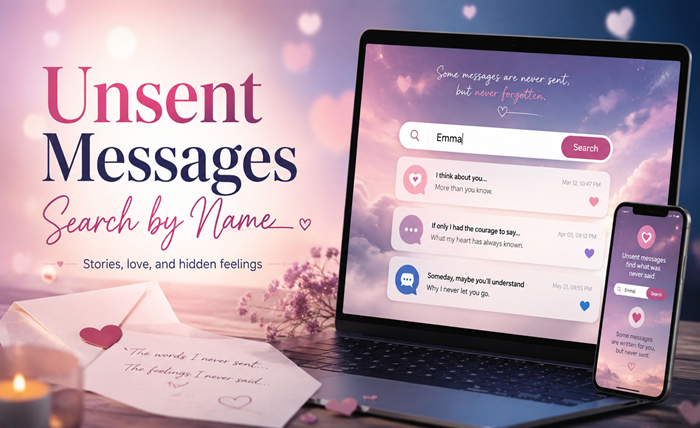
unsent messages search by name has become a surprisingly emotional phrase for people who are curious about words that were written but never delivered. Maybe you are wondering whether someone once wrote something about you. Maybe you have an ex, a first love, an old friend, or someone you still think about from time to time. The idea that their unsaid feelings could exist somewhere online can be difficult to ignore.
Unsent messages have a strange power because they represent conversations that never happened. They hold apologies that came too late, confessions that felt too frightening to send, and feelings people simply could not put into a real conversation.
That is why people searching for unsent messages are not always looking for entertainment. Often, they are looking for understanding.
Some want closure after a relationship ended. Others are curious about a person they once loved. Some simply enjoy reading anonymous stories because they recognise their own feelings in someone else’s words.
Searching by a person’s name can make the experience feel even more personal. A familiar name appearing beside an emotional message can instantly make you wonder, Could this be about me?
However, it is important to remember that anonymous unsent-message websites usually do not verify who wrote each message or who the message is really about. A matching name does not prove that someone you know wrote it.
Still, the experience can be meaningful. Sometimes the real value is not discovering who wrote a message but understanding the emotions the message brings out in you.
unsent messages uk
Interest in unsent messages UK has grown as more people discover anonymous message-sharing platforms through social media, search engines, and online communities.
People across the United Kingdom use these types of platforms for many of the same reasons people do elsewhere: heartbreak, nostalgia, regret, friendship, unfinished relationships, and things they wish they had said.
Imagine someone from London writing:
“I passed our old coffee shop today. I wanted to tell you that I still remember exactly what you used to order.”
The message might never be sent directly to the person it was meant for. Instead, posting it anonymously gives the writer somewhere to place the feeling.
That is one reason unsent-message communities can feel comforting. You quickly realise that emotions you thought were uniquely yours are shared by thousands of people.
Someone in Manchester may be struggling to forget a former partner. Someone in Birmingham may still think about a childhood friend. Someone in Glasgow might be carrying an apology they never had the courage to give.
Different people, different stories, but very similar emotions.
When searching for UK-related unsent messages, users may also look for a specific name. This creates the feeling of searching through a giant collection of emotional memories.
But there is an important distinction between curiosity and certainty.
If you find a message addressed to “Sarah,” for example, and you know someone named Sarah, that alone does not establish any connection. Thousands of people share the same name.
The healthiest way to explore these messages is to treat them as anonymous expressions rather than confirmed personal communications.
unsent messages uk
There is another reason unsent messages UK searches can become so addictive: people often return because they are hoping to find something that feels familiar.
A name, a city, a relationship detail, or even a particular phrase can make an anonymous message suddenly feel personal.
Suppose you once had a relationship that ended without a proper goodbye. Years later, you find an anonymous message saying:
“You probably think I forgot you. I didn’t. I just learned how to live without calling you.”
Even if the message has nothing to do with your relationship, it may still connect with something inside you.
This is where unsent messages become more than simple text.
They act almost like emotional mirrors.
You read a stranger’s confession and suddenly remember a conversation from five years ago. You see someone’s apology and think about the apology you never received. You read about a first love and remember the person who once meant everything to you.
For UK readers, cultural differences do not change the basic emotional experience. Love, regret, jealousy, missing someone, and wanting closure are universal feelings.
The best approach is to enjoy the stories without building assumptions around them.
A message can remind you of someone without necessarily being written by that person.
And sometimes that is enough.
unsent project uk
The phrase unsent project UK is often searched by people trying to discover collections of anonymous emotional messages associated with projects such as The Unsent Project and similar online concepts.
The basic idea is fascinating: people submit messages they wish they could send to someone important from their past or present.
These could include romantic partners, parents, friends, classmates, siblings, or complete strangers who briefly changed someone’s life.
What makes the concept powerful is its honesty.
When people know they do not have to send the message directly, they often say things they would normally hide.
They may write:
“You changed my life without ever knowing it.”
Or:
“I wish I had treated you better when you were still here.”
Or simply:
“I miss you.”
Three words can carry years of emotion.
For people searching from the UK, the project can become a fascinating way to explore human relationships. You may search common British names or names belonging to people from your own life.
But again, anonymous submissions should not be treated as verified messages from identifiable individuals.
Think of the project less like a private mailbox and more like an enormous emotional archive.
People contribute fragments of their lives, and everyone else gets to read them.
That anonymity is part of what makes the experience so powerful.
When names and identities disappear, emotions become the main focus.
You stop thinking about exactly who wrote the message and start thinking about why someone might feel that way.
unsent messages to ex
Few categories carry as much emotion as unsent messages to ex partners.
After a breakup, people often have dozens of things they want to say.
Some messages are angry.
Some are loving.
Some are full of regret.
Others simply ask questions that may never receive an answer.
A breakup does not always mean feelings disappear immediately. Sometimes two people stop communicating while both still carry thoughts about each other.
That is where unsent messages become especially relatable.
Someone might write:
“I don’t want us back together. I just wish our ending had been kinder.”
Another person may write:
“I finally understand why you left.”
And someone else might admit:
“I still compare everyone I meet to you.”
These messages reveal an important truth about relationships: closure does not always arrive at the same time as the breakup.
You can stop dating someone months or years before emotionally accepting what happened.
Writing an unsent message can help people organise their feelings without reopening communication that may no longer be healthy or appropriate.
It gives the writer a chance to say everything without expecting a reply.
Readers are drawn to these messages because nearly everyone who has experienced heartbreak recognises at least one of these emotions.
If you are searching a former partner’s name, however, try not to assume that every matching message came from them.
When we miss someone, the mind naturally searches for signs.
A song feels like a sign.
A social-media post feels like a sign.
And an anonymous message containing their name can feel like another one.
Sometimes it is healthier to ask what the message makes you feel instead of trying to prove who wrote it.
Maybe it reveals that you still want closure.
Maybe it reminds you that you have moved on.
Maybe it helps you finally put your own feelings into words.
That can be valuable even when the message belongs to a complete stranger.
unsent letters to first love
There is something especially nostalgic about unsent letters to first love.
First love often stays in memory differently from later relationships.
It may have happened during school, university, or a period of life when everything felt new. Because of that, memories of the person can become connected to memories of who you were at the time.
Years later, people may no longer want the relationship back, yet they still wonder about the person.
Where are they now?
Do they remember me?
Did I matter to them as much as they mattered to me?
Would things have been different if we had met later in life?
These questions can stay unanswered for decades.
An unsent letter gives those questions somewhere to exist.
A person might write:
“You were the first person who made me understand what it meant to miss someone.”
Another might say:
“We were too young to understand what we had, but I am grateful it happened.”
Unlike messages to a recent ex, letters to a first love are often less about getting someone back and more about remembering.
Time changes the emotion.
Pain becomes nostalgia.
Anger becomes understanding.
And sometimes heartbreak becomes gratitude.
That is why first-love messages are among the most powerful pieces to read. They remind us that some relationships can be important even when they are not permanent.
Your first love might not be your forever love.
But they may still be part of the story that shaped you.
Searching a first love’s name in an anonymous collection can therefore feel intensely personal. Just remember that finding the same name does not mean you have discovered a letter from that particular person.
Let the message be meaningful without forcing it to become proof.
unsent message to someone you love
Writing an unsent message to someone you love is not always about heartbreak.
Sometimes you love someone deeply but cannot tell them.
Perhaps they are already in another relationship.
Maybe you are afraid they do not feel the same way.
Perhaps circumstances have separated you.
Or maybe the person knows you love them, but there are still things you cannot find the courage to say.
An unsent message creates a private space for honesty.
You can write:
“I hope life is gentle with you, even if I am no longer part of it.”
Or:
“There are so many ordinary moments when I still wish you were beside me.”
Sometimes writing the words is enough.
You do not always need to send every feeling you experience.
In fact, one of the most mature things we can learn is that having an emotion does not automatically mean we must act on it.
Writing allows you to acknowledge the feeling without placing pressure on another person.
That is part of the beauty of unsent messages.
They sit somewhere between silence and conversation.
The words exist.
The feelings are recognised.
But the recipient does not necessarily have to carry them.
For readers, these messages can also provide comfort. Seeing other people struggle with the same emotions can reduce the loneliness that often comes with unspoken love.
You realise that many people have loved quietly.
Many people have missed someone they could not contact.
Many people have written messages and deleted them before pressing send.
You are not reading perfect love stories.
You are reading human ones.
Why Unsent Messages Feel So Personal
The biggest reason people become interested in anonymous message collections is simple: our brains naturally connect stories to our own experiences.
If you read a message saying:
“I still think about that rainy afternoon when we said goodbye.”
you may immediately remember your own goodbye.
The writer’s rainy afternoon becomes connected to your memory.
This is why unsent messages search by name can feel almost magnetic.
A name adds another layer of familiarity.
Instead of reading an anonymous message to “someone,” you may see a name belonging to your former partner, friend, or first love.
Suddenly the story feels closer.
But emotional similarity is not evidence of identity.
Millions of people experience similar relationships, arguments, breakups, and memories.
That universality is actually what makes these collections fascinating.
A stranger can describe an emotion you have never been able to explain yourself.
Can You Really Find Someone’s Message by Their Name?
This is one of the biggest questions people have when performing an unsent messages search by name.
The answer requires realistic expectations.
Searching by name may help you find messages associated with that name on platforms that support search functionality.
What it generally cannot do is prove who actually wrote the message.
Anonymous projects are designed around anonymity.
A message addressed to “Daniel” could refer to thousands of different people named Daniel.
Even specific details may be coincidences.
For this reason, it is better to view name search as a discovery tool rather than an identification tool.
You can search.
You can read.
You can relate.
But you should be careful about making conclusions about real people.
Why People Write Messages They Never Send
There are countless reasons.
Fear is one.
Pride is another.
Sometimes people simply realise sending the message would not improve the situation.
Imagine writing a long message to an ex at two in the morning. In that moment, sending it might feel essential.
After sleeping, however, you may realise you were expressing temporary emotions rather than something that needed to become a new conversation.
Writing gave you relief without creating another problem.
People also write unsent messages when communication is impossible.
The recipient may have moved away.
Contact may have been lost.
The relationship may have ended permanently.
In some cases, the person may no longer be alive.
Writing then becomes less about communication and more about expression.
The message may never reach the intended recipient, but it still helps the writer acknowledge what they feel.
Should You Send Your Unsent Message?
Sometimes yes.
Sometimes absolutely not.
The answer depends on the relationship, the message, and your reason for wanting to send it.
Before sending anything emotional, ask yourself three questions.
What outcome am I expecting?
If you secretly expect reconciliation, an apology, or a particular response, recognise that the other person may not respond the way you hope.
Will this message help the other person or only relieve me?
Emotional honesty matters, but we also need to consider boundaries.
Will I still feel comfortable about sending this tomorrow?
Waiting before sending an emotional message can prevent many regrets.
You can always write something today and decide tomorrow whether it belongs in someone’s inbox.
There is no rule saying every truthful thought needs to be delivered.
Finding Meaning Without Finding the Writer
Perhaps the most interesting thing about unsent messages search by name is that you may begin the search hoping to find someone else but end up understanding yourself.
Maybe you search your ex’s name.
You read twenty messages.
None can be proven to be theirs.
But one sentence stays with you.
It makes you realise that you have been waiting for an apology you may never receive.
Another message makes you remember how much you have changed.
Another reminds you that the relationship was meaningful even though it ended.
In that way, the search still gave you something valuable.
Not proof.
Perspective.
And sometimes perspective is more useful than finding the exact person behind the words.
Final Thoughts
Unsent messages search by name combines curiosity, nostalgia, love, heartbreak, and the very human desire to know what other people truly feel.
Whether you are exploring unsent messages UK, looking into the unsent project UK, reading unsent messages to ex partners, discovering unsent letters to first love, or searching for an unsent message to someone you love, the experience can become surprisingly emotional.
Just remember what these messages really are: anonymous expressions.
A familiar name may make your heart beat faster, but it does not automatically identify the writer.
Read them for the stories.
Read them for the emotions.
Read them because sometimes a stranger can find the exact words for something you have carried silently for years.
And if you feel inspired to write your own unsent message, you do not necessarily need to send it.
Sometimes writing the words is the closure.
Sometimes keeping them unsent is the point.



No comments yet. Be the first to share your thoughts!