

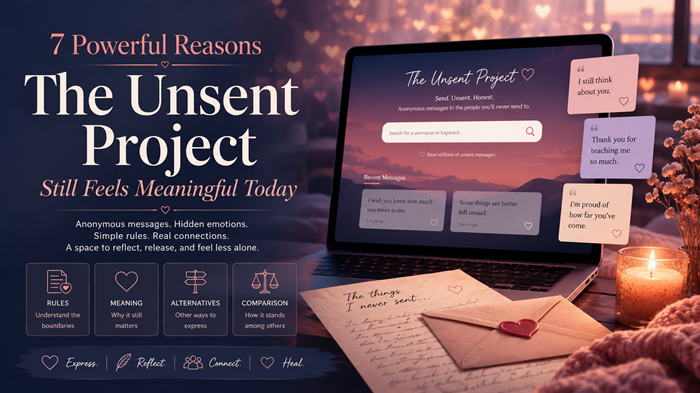
The Unsent Project is one of those online spaces that looks simple at first but can quickly become emotional. The basic idea revolves around words people wanted to say to someone but never actually sent. Those words might be about love, regret, heartbreak, friendship, gratitude, anger, or a memory that still feels unfinished.
That simplicity is exactly what makes the concept so powerful.
Most of us have written a message and deleted it. Maybe we typed a long paragraph to an ex and decided not to send it. Maybe we wanted to apologise to an old friend but waited too long. Sometimes we simply had feelings we could not explain at the right moment.
Projects built around unsent messages give those thoughts somewhere to exist.
People often visit The Unsent Project because they are curious about a name. They may search for themselves, a former partner, a first love, or somebody they still remember. But many visitors eventually realise that the experience is not really about proving who wrote a particular message.
It is about recognising emotions.
You might read a sentence written by a complete stranger and think, That is exactly what I wanted to say.
That feeling of emotional recognition is one of the main reasons anonymous message projects continue to attract attention. They turn private thoughts into shared experiences without requiring a direct conversation between two people.
Still, anyone exploring these platforms should understand how they work, what their limitations are, and why anonymous messages should never automatically be treated as proof about a real person.
This guide explores the meaning behind the project, common rules users should understand, possible alternatives, similar platforms, and the differences between different unsent-message concepts.
unsent project rules
When people search for unsent project rules, they are usually trying to understand what they can submit, what kind of content is acceptable, and whether there are limits on how the platform should be used.
The exact submission policies of any website can change over time, so users should always check the current official guidelines before posting. However, anonymous message communities generally work best when people follow a few basic principles.
The first is simple: write about your own feelings.
An unsent message should express something you genuinely wanted to say. It might be a confession, apology, goodbye, memory, or emotional thought. The value comes from honesty rather than trying to create drama or attract attention.
For example:
“I wish I had told you how much your friendship meant to me.”
That type of message communicates emotion without attacking anyone.
Another important principle is respecting privacy.
Because these projects involve real feelings and sometimes real names, users should avoid revealing highly identifying information about another person. A first name may be part of the concept, but posting someone’s private phone number, home address, workplace details, or other sensitive information would cross a very different line.
Anonymous projects are about emotional expression, not exposing somebody.
Users should also avoid treating the platform as a way to publicly harass, threaten, or shame another person. There is a major difference between saying:
“You hurt me, but I am trying to move on.”
and writing something designed to intimidate or encourage harassment.
The first expresses a feeling.
The second creates harm.
Another unwritten rule is not to assume ownership of a message simply because a name matches.
Suppose your name is Emma and you find a message addressed to Emma saying:
“I still think about the night we met.”
It may feel incredibly personal.
But there could be thousands of people named Emma. Without verified information, there is no reliable way to conclude that the message is about you.
That is one of the most important unsent project rules to keep in mind as a reader: enjoy the emotional connection, but do not turn an anonymous post into evidence.
The healthiest way to use The Unsent Project is as a place for reflection rather than investigation.
Read the messages.
Think about what they make you feel.
Maybe write your own.
But respect the anonymity that makes the entire idea work.
what is the unsent project
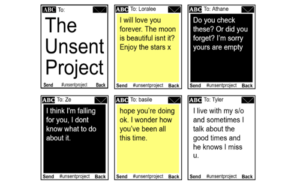
If you are wondering what is the unsent project, the easiest way to understand it is as an archive of messages people chose not to send directly to their intended recipients.
These messages may be written to first loves, former partners, friends, family members, crushes, or people who left a lasting impression.
The messages are often short.
That is part of their appeal.
A few words can carry an enormous amount of history.
Someone might write:
“I hope you became the person you wanted to be.”
Another person might say:
“I forgive you, but I still remember.”
And somebody else may simply write:
“Thank you for staying when everyone else left.”
Without context, we do not know the entire story.
But that mystery gives readers room to connect the message with their own experiences.
The project also reflects something almost everyone understands: sometimes the most important things in our lives are the things we never said.
People stay silent for many reasons.
They may be afraid of rejection.
They may not want to reopen an old relationship.
Perhaps too much time has passed.
Maybe the recipient is no longer reachable.
Sometimes the writer simply knows that sending the message would not improve the situation.
Writing it, however, can still feel meaningful.
That is why The Unsent Project can function almost like a public collection of private emotional moments.
You are not necessarily reading complete stories.
You are reading fragments.
One message may represent a ten-year relationship.
Another may represent a five-minute conversation that someone never forgot.
The length of the relationship does not always determine the strength of the memory.
And that is one of the most interesting parts of the entire concept.
unsent project alternative
Someone searching for an unsent project alternative may be looking for a different way to write, share, or read messages that were never delivered.
The right alternative depends on what you actually want from the experience.
If your goal is emotional expression, you do not necessarily need a public platform at all.
A private journal can work beautifully.
Write the person’s name at the top of the page and then write everything you wish you could say.
Do not edit yourself.
Do not worry about grammar.
Do not ask whether the message sounds impressive.
Simply write.
You may discover that the act of putting the emotion into words is more important than publishing it.
Another alternative is writing a letter that you never mail.
This feels more personal than typing because handwriting slows you down. You have more time to think about every sentence.
Some people keep these letters.
Others destroy them afterward as a symbolic way of letting go.
A private notes app can also become an unsent project alternative.
You could create a folder called “Unsent” and place messages there whenever you feel the urge to contact someone impulsively.
Come back a day later.
You may still want to send the message.
Or you may realise that writing it was enough.
For people who enjoy community interaction, anonymous confession or storytelling communities can offer a similar emotional experience, although each platform has different privacy policies and moderation standards.
The key is choosing the format that matches your goal.
If you want public emotional connection, an anonymous community may appeal to you.
If you want personal closure, private writing may be better.
If you want an actual conversation with someone, then an unsent-message platform may not be the right tool at all.
Sometimes what we really need is not another anonymous message.
Sometimes we need to decide whether a respectful, direct conversation is appropriate.
sites like unsent project
People searching for sites like unsent project are often looking for online spaces where they can read anonymous confessions, share emotional thoughts, or write messages without sending them directly.
There are many types of communities that can provide a similar experience, even if their formats are different.
Anonymous confession platforms are one category.
These websites allow people to share things they do not feel comfortable discussing publicly under their real identity.
Some focus on relationships.
Others include broader personal experiences.
Online forums can also provide similar emotional storytelling. People sometimes create threads about letters they never sent, things they wish they had told an ex, or messages they would give their younger selves.
The experience is different from The Unsent Project, but the emotional theme can be very similar.
Private digital journaling platforms are another option.
They do not provide the same public archive, but they can be safer for people who mainly want to process feelings privately.
There are also social media communities built around anonymous letters, heartbreak stories, missed connections, or relationship confessions.
However, privacy should always come first.
Before posting to any of these communities, check what information becomes public.
Ask yourself whether you would still be comfortable with the message existing online years from now.
Anonymity can reduce the connection between your identity and your words, but it does not automatically guarantee total privacy.
The best sites like unsent project are therefore not simply the ones with the biggest collections.
They are the ones that clearly explain their privacy approach, moderate harmful content, and give users reasonable control over what they share.
unsent project vs unsent message project
The search unsent project vs unsent message project can become confusing because people sometimes use similar phrases for different websites, concepts, or collections of anonymous messages.
The first thing to understand is that similar names do not necessarily mean two platforms are operated by the same organisation.
One project may focus mainly on messages connected to first loves.
Another may accept broader anonymous letters.
A different website might organise messages by name, emotion, colour, category, or relationship type.
That is why you should look at the actual platform rather than relying only on the title.
When comparing The Unsent Project with another unsent message project, consider several things.
First, look at the purpose.
Is the platform designed around romantic messages, or can users write about anyone?
Second, look at how messages are organised.
Can you search by name?
Are messages grouped by topic?
Is there an archive?
Third, examine privacy.
Does the site explain how submissions are displayed?
Can identifying information appear publicly?
Are messages reviewed before publication?
Fourth, think about moderation.
Anonymous platforms can attract highly emotional content, so responsible moderation matters.
Finally, consider the overall experience.
Some people want to search names.
Others want to read random messages.
Some visitors want to submit something of their own.
There is no single platform that will be perfect for everyone.
The important thing is to understand what each service actually offers.
A platform should not be considered more authentic simply because the name sounds familiar.
Always use the official website and current information when deciding where to submit personal writing.
Why The Unsent Project Feels So Personal
One reason The Unsent Project connects with so many people is that human beings naturally attach meaning to familiar names and situations.
Imagine reading:
“I wish we had one more summer together.”
You might immediately remember somebody.
The writer could be thinking about a completely different person in a different country.
But the feeling becomes yours for a moment.
That is the strange beauty of anonymous writing.
The story is someone else’s.
The emotion can still belong to you.
Names make that effect even stronger.
If you see the name of an ex, friend, or first love, your brain immediately begins comparing the anonymous message with your own history.
This does not mean you have discovered a secret message from that person.
It simply shows how strongly memory and emotion are connected.
Why People Write Things They Never Send
There are countless reasons people leave messages unsent.
Timing is one.
Fear is another.
Sometimes we know that sending a message would only create more confusion.
Imagine writing to an ex at midnight:
“I still miss you.”
In that moment, sending it may feel essential.
The next morning, you may realise you miss the memory of the relationship rather than the relationship itself.
Writing helped you discover that.
People also stay silent because they want to respect another person’s boundaries.
A relationship may be over.
Someone may have asked for space.
Contacting them again may not be appropriate.
An unsent message allows you to acknowledge the feeling without forcing the other person into a conversation.
That distinction matters.
Not every emotion requires action.
Sometimes accepting the emotion is enough.
Can An Anonymous Message Give You Closure?
Maybe—but probably not in the way people first imagine.
When people visit The Unsent Project, they sometimes hope to discover a message from somebody specific.
They imagine finding an apology.
A confession.
A statement that proves the other person still remembers them.
But anonymous messages cannot reliably provide that kind of certainty.
What they can provide is perspective.
You might read someone else’s goodbye and realise you never properly accepted your own.
You might read an apology and understand what you wish somebody had told you.
You may see a message about moving on and realise that you are finally ready to do the same.
That kind of closure comes from inside you.
The anonymous message simply helped you find it.
Should You Send the Message Instead?
This depends entirely on the situation.
Before sending an emotional message, ask yourself why you want to send it.
Do you genuinely have something useful or respectful to communicate?
Or are you hoping the other person will respond in a particular way?
If you are expecting them to apologise, return, explain themselves, or make you feel better, remember that you cannot control their response.
Also consider their boundaries.
If someone has clearly asked for no contact, an unsent message may be the better place for your feelings.
On the other hand, if there is no harmful history or boundary issue and you simply owe someone a sincere apology or thank-you, respectful communication may sometimes be meaningful.
The important thing is not whether a message is sent.
It is whether sending it is thoughtful and appropriate.
The Real Meaning Behind Unsent Messages
At its heart, The Unsent Project is interesting because it captures something very ordinary and very human.
We all edit ourselves.
Every day, people choose what to say and what to keep inside.
Most unsent thoughts disappear.
Projects like this give some of them a place to remain.
They remind us that someone can look completely fine while carrying a conversation they have replayed in their mind hundreds of times.
A short message can represent years of regret.
A single sentence can contain an entire relationship.
And sometimes a stranger can describe a feeling more clearly than we ever could.
Final Thoughts
The Unsent Project is more than a collection of short anonymous messages. Its appeal comes from the emotions behind those words and the unfinished conversations nearly everyone carries at some point.
Whether you are researching unsent project rules, asking what is the unsent project, looking for an unsent project alternative, exploring sites like unsent project, or comparing unsent project vs unsent message project, the most important thing is to approach anonymous content with realistic expectations.
A familiar name does not prove identity.
An emotional message does not confirm who wrote it.
And a coincidence should not become an accusation or assumption.
Instead, use these messages for what they can genuinely offer: reflection.
They can remind you of someone.
They can help you recognise an emotion.
They may inspire you to write something you have carried silently for years.
And sometimes that is enough.
Not every message needs a reply.
Not every story needs another chapter.
Sometimes the words simply need somewhere to exist.


No comments yet. Be the first to share your thoughts!