

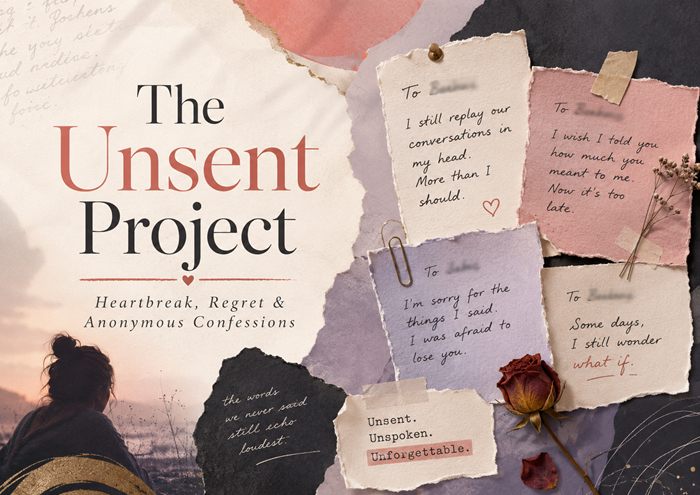
The Unsent Project has a way of making people stop scrolling.
At first, you may visit simply because you are curious. You might want to search a familiar name, read a few anonymous messages, or see what other people were too afraid to say out loud.
Then one message catches your attention.
Maybe it sounds like something you once wanted to tell an ex. Maybe it reminds you of a friend you lost contact with. Perhaps it brings back a memory you thought you had already moved past.
That is what makes The Unsent Project so interesting. The messages are usually short, but the feelings behind them can be enormous.
Some people write about love.
Others write about disappointment.
Some are still angry.
Some have forgiven.
And some simply want to put a feeling somewhere because keeping it inside has become too heavy.
An unsent message might say:
“I hope you know I never hated you. I was just hurt.”
Another might say:
“I still think about the life we almost had.”
A few words can carry years of history.
The people reading these messages may never know the full story. They do not know what happened before the message was written, why it stayed unsent, or whether the intended person ever found it.
And perhaps that mystery is part of the appeal.
You are given only a fragment.
Your own memories fill in the rest.
For many people, The Unsent Project is not really about finding a secret message from someone specific. It is about recognising a feeling they have experienced themselves.
That is why messages about heartbreak, regret, confessions, former relationships, and things left unsaid can feel so personal—even when they were written by complete strangers.
anonymous confession messages uk
The popularity of anonymous confession messages UK searches shows how strongly people are drawn to spaces where they can express something without attaching their full identity to it.
There is a freedom in anonymity.
When people do not have to look someone in the eye or wait for an immediate response, they may become more honest about how they feel.
Someone in London might write about a relationship that ended years ago.
Someone in Manchester could finally admit that they miss an old friend.
A person in Birmingham may confess feelings they never had the courage to share.
The locations are different, but the emotions are familiar.
Love, jealousy, regret, loneliness, gratitude, disappointment, and nostalgia do not belong to one city or one country.
Anonymous platforms give these emotions somewhere to exist.
That is one reason The Unsent Project and similar concepts feel so universal.
People can read a message from someone they will never meet and still think:
“I know exactly what that feels like.”
Anonymous confession messages are not always romantic either.
A person may write to a parent:
“I wish you knew how hard I tried to make you proud.”
Someone might write to an old friend:
“I still don’t understand how we became strangers.”
Another person may write to themselves:
“I wish I had been kinder to the person I was back then.”
These are confessions in the broadest sense.
They are truths people have carried quietly.
For UK readers, anonymous message communities may also feel appealing because they allow people to explore emotions without turning everything into a public social-media identity.
But anonymity should still be treated carefully.
An anonymous message does not mean privacy is unlimited, and it should never be used to expose someone else’s personal information.
The healthiest confessions focus on the writer’s own feelings rather than identifying, attacking, or humiliating another person.
The power is in honesty, not exposure.
things left unsaid messages
There is something haunting about things left unsaid messages because almost everyone has at least one.
Think about your own life.
Is there someone you wish you had thanked?
Someone you wanted to apologise to?
A person you loved but never told?
Someone you wish you had asked to stay?
Most people can think of a name almost immediately.
That is why messages about things left unsaid can be more emotional than long, detailed stories.
A simple sentence like:
“I should have called you one last time.”
can contain an entire relationship.
We do not know who the people were.
We do not know what happened.
Yet the sentence is enough.
Our own experiences give it meaning.
People leave things unsaid for many reasons.
Sometimes they are afraid.
Sometimes pride gets in the way.
Sometimes the right moment never comes.
And sometimes people realise what they wanted to say only after the relationship has already changed.
The painful part is that life does not always provide another opportunity.
A friendship can end unexpectedly.
A person can move away.
A relationship can become too distant to reopen.
Years later, the words may still remain.
That is where The Unsent Project becomes emotionally interesting.
It gives people a place for those unfinished sentences.
Writing the message does not change the past.
It does not guarantee closure.
But it can help the writer acknowledge something they have been avoiding.
Sometimes saying the words privately is the first step toward understanding the feeling.
And sometimes understanding is enough.
Not every unfinished conversation needs to become a new conversation.
Some simply need to be recognised.
unsent letters to exes
Few topics are as emotionally complicated as unsent letters to exes.
When a relationship ends, communication often ends before the feelings do.
People may stop calling each other.
They may unfollow each other.
They may remove old photographs.
But that does not mean every thought disappears at the same time.
Months later, a person may suddenly think of something they wish they had said.
Years later, they may understand the breakup differently.
An unsent letter allows that new understanding to exist without necessarily reopening the relationship.
Someone might write:
“I blamed you for everything because it was easier than admitting I was hurt.”
Another might say:
“I don’t want you back. I just wanted our ending to be kinder.”
And another:
“Thank you for teaching me what I should never accept again.”
These messages show how complicated heartbreak can be.
You can miss someone and still know the relationship was wrong for you.
You can forgive someone without wanting them back.
You can remember happy moments without wishing to return to the past.
That emotional complexity is what makes The Unsent Project relatable.
Real relationships rarely fit into simple categories like good or bad.
People can love each other and still hurt each other.
Two people can care deeply and still be unable to build a healthy life together.
Writing an unsent letter can help someone separate those feelings.
Instead of sending an emotional message late at night, they can write everything down and revisit it later.
Sometimes the urge to contact the ex disappears.
Sometimes the message reveals that what they actually miss is not the person but the version of life they had during that period.
And occasionally, writing makes someone realise that they are finally ready to let go.
An unsent letter can therefore become less about the ex and more about the writer’s own growth.
unsent messages heartbreak
Unsent messages heartbreak is one of the most natural themes in anonymous message communities because heartbreak creates an enormous amount of unfinished emotion.
After a breakup, people often replay conversations.
They wonder what they could have done differently.
They remember the good moments more clearly than the bad ones.
They imagine alternative endings.
That is normal.
When someone was part of your everyday life, losing that connection can leave a strange silence behind.
You may still have the instinct to tell them about your day.
You may hear a song and immediately think of them.
You may visit a place you used to go together and feel the memory before you even understand why.
Those moments often become unsent messages.
“I saw your favourite coffee today and almost bought it for you.”
“I finally watched the movie you kept telling me about.”
“I hope you’re okay. I just know I shouldn’t ask.”
These messages can be heartbreaking precisely because they are ordinary.
They are not dramatic declarations.
They are small reminders that someone used to be part of everyday life.
One reason people read The Unsent Project is because heartbreak can feel isolating.
When you are hurting, it is easy to believe that nobody else understands the exact combination of love, anger, confusion, and longing you feel.
Then you read a stranger’s message that describes it perfectly.
For a moment, you feel understood.
The writer does not know you.
You do not know them.
But the emotion connects you.
That is part of the strange comfort anonymous messages can provide.
They do not fix heartbreak.
But they remind you that heartbreak is a human experience shared by countless people.
unsent messages regret
Unsent messages regret often carry a different emotional weight.
Heartbreak is frequently about what happened to us.
Regret is often about what we wish we had done differently.
That distinction can be painful.
A person may regret not speaking.
They may regret speaking too harshly.
They might wish they had stayed.
Or they may wish they had left sooner.
One message could say:
“I should have believed you when you told me you were struggling.”
Another might read:
“I wish I had apologised when I still had the chance.”
Regret is difficult because the past cannot be edited.
We can understand our mistakes more clearly with time, but understanding does not automatically give us another opportunity.
This is one reason The Unsent Project can feel almost like an emotional time capsule.
People write from the present to someone who belongs to their past.
The person they are today is speaking to a relationship that existed years earlier.
Sometimes the most meaningful part of an unsent regret message is not whether the intended recipient ever reads it.
It is that the writer can finally admit the truth.
Maybe they were wrong.
Maybe they were afraid.
Maybe they did not understand the consequences of their actions at the time.
Saying:
“I made a mistake,”
even anonymously, can be difficult.
But it can also be a sign of growth.
Regret becomes unhealthy when we use it only to punish ourselves.
It becomes useful when it teaches us something.
An unsent message cannot repair every relationship, but it can help someone decide how they want to behave differently in the future.
Why The Unsent Project Feels More Personal Than Social Media
Most social media encourages people to show what they want others to see.
Happy photographs.
Achievements.
Trips.
Celebrations.
Even difficult moments are often carefully presented.
Anonymous messages are different.
There is less pressure to look impressive.
A person can simply say:
“I am not over you.”
Or:
“I wish someone had noticed I was struggling.”
That rawness can make The Unsent Project feel more intimate than a polished social feed.
You are seeing a thought that may never have been intended for a normal audience.
That creates a strange feeling of closeness.
But it is still important to remember that anonymous messages are not verified personal communications.
A familiar name or situation does not prove that someone you know wrote the message.
The emotional connection can be real without the identity being known.
Why We Search for Familiar Names
Names carry emotional weight.
If you see a random message saying:
“I still remember you,”
you may think it is touching.
But if the same message contains the name of your ex, your first love, or yourself, your reaction may be completely different.
The mind immediately starts connecting details.
Could this be them?
Could this be about me?
That curiosity is understandable.
But many people share the same names and similar experiences.
A message to “Sarah” could refer to thousands of different people.
A breakup after university is not unique.
Neither is missing someone after years of silence.
The healthiest way to browse The Unsent Project is to allow messages to feel meaningful without treating them as proof.
Sometimes the reason a message feels familiar is simply that human emotions are more universal than we realise.
Can Writing an Unsent Message Help?
For many people, writing can create clarity.
Thoughts inside the mind can feel chaotic.
Once they are written down, they become easier to examine.
You might begin writing:
“I miss you.”
Then, after a few paragraphs, realise:
“Actually, I miss who I was when we were together.”
That is an important difference.
Writing can reveal what is underneath the first emotion.
Anger may hide sadness.
Longing may hide loneliness.
Regret may hide a desire for forgiveness.
You do not have to publish the message.
You do not have to send it.
The simple act of writing can be enough to help you understand what you are carrying.
Should Every Unsent Message Stay Unsent?
Not necessarily.
Sometimes a message contains a sincere apology, thank-you, or something that could be healthy to communicate.
But before sending it, ask yourself a few questions.
Why do I want to send this?
Am I respecting the other person’s boundaries?
Am I expecting a particular response?
Would I still send this tomorrow?
These questions matter because sending a message changes the situation.
Writing is private.
Sending involves another person.
If the recipient has asked for no contact, respecting that boundary should come before your desire to express the feeling directly.
In that case, keeping the message unsent may be the kinder choice.
The Quiet Comfort of Reading Other People’s Words
One of the most powerful things about The Unsent Project is that it can make loneliness feel less absolute.
You realise that other people also miss someone.
Other people also regret things.
Other people have written apologies that were never delivered.
Other people have stared at a message for ten minutes and then deleted it.
There is comfort in recognising that you are not the only person carrying unfinished words.
It does not erase the past.
But sometimes knowing that another human being understands the emotion is enough to make it feel a little lighter.
Final Thoughts
The Unsent Project continues to connect with people because it captures something almost everyone understands: there are words we carry that never find their way to the person they were meant for.
Whether you are reading anonymous confession messages UK, exploring things left unsaid messages, looking through unsent letters to exes, relating to unsent messages heartbreak, or thinking about unsent messages regret, the emotional core is remarkably similar.
People want to be understood.
They want to say what they could not say at the time.
Sometimes they want forgiveness.
Sometimes they want closure.
And sometimes they simply want their feelings to exist somewhere outside their own mind.
Anonymous messages cannot tell you with certainty what somebody from your past thinks about you.
They cannot rewrite a relationship.
They cannot guarantee closure.
But they can offer something quieter.
Perspective.
Recognition.
A reminder that another person, somewhere, has felt something surprisingly similar.
And occasionally, reading a stranger’s unsent words helps you finally understand your own.
Maybe that is why The Unsent Project remains meaningful.
The messages may be unsent.
But the feelings behind them are very real.


No comments yet. Be the first to share your thoughts!