

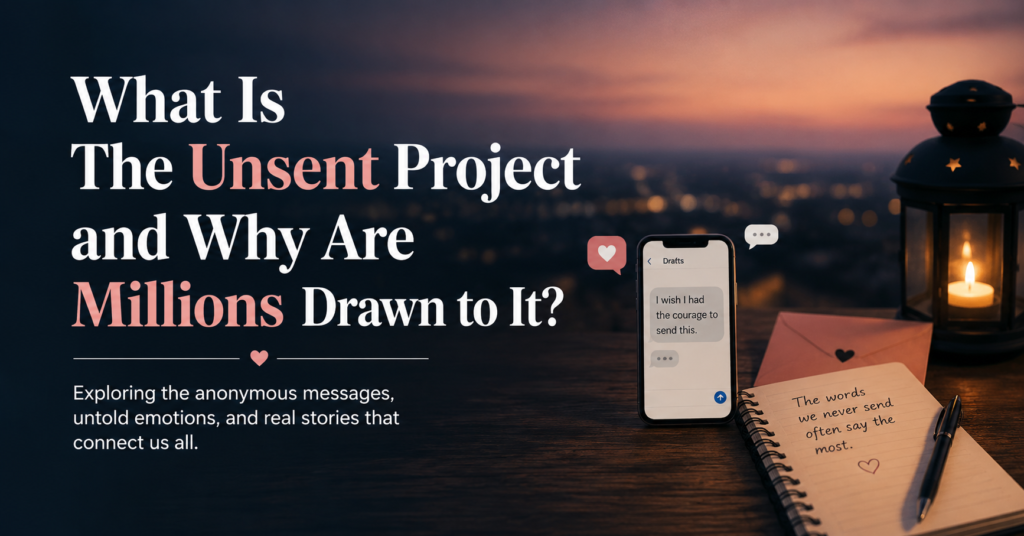
In a world where people communicate instantly, it is common to find that many messages never reach a destination. There are unsent drafts, deleted digital texts and letters that stay inside notebooks. It is in those silent words that people store feelings that are strong and sincere. Because of this fact, The Unsent Project is a subject that individuals around the world notice.
As a basic definition, The Unsent Project is a collection of anonymous messages for people who affected a life in a significant way. For the writer the recipient is a former partner, a close friend, a relative or someone who is dead. With this archive, individuals will be able to articulate an emotion that they were previously unable or unwilling to express.
It is a straightforward idea, yet its emotional significance cannot be underestimated.
Why Anonymous Messages Matter
Many different events can occur before the dispatching of a written message. At times, however, no matter what the reason, the message never gets delivered.
The content of such a message is often made up of:
- Love confessions
- Apologies
- Thank yous
- Post-breakup regret
- Goodbyes
- Unresolved thoughts
These emotions can get locked up and even fester for many years. The Unsent Project gives people a safe space to express these bottled feelings anonymously, with minimal fear of consequences. Through The Unsent Project, many individuals find comfort in sharing emotions they were never able to say out loud.
The result is a number of holistic and sincere human messages of which the experiences may be, to many, surprisingly relatable.
More Than Just Messages
Many people assume these archives are only about romance. In reality, the emotional landscape is much broader.
MThese types of messages are common:
- Ex-love’s
- First loves
- Childhood friends
- Mother’s
- Father’s
- Brothers
- Sisters
- Mentors
- Teachers
- Lost loves
- Favorite pets
This diversity helps form an emotional library. It is comprised of stories of heartbreak, love, forgiveness, nostalgia, hope, and of course, healing. You may witness each of these within the scope of a single visit to this site.
Why People Connect So Deeply With It
The reason anonymous message archives have taken off is no accident. They resonate on a very basic human level, tapping into feelings most of us have had. For one, it feels very real, the opposite of what usually passes for real life on social media feeds. You see thoughts from people instead of edited memories of what they believe life has been like.
Secondly, they are extremely relatable. While it’s likely that someone on these sites hasn’t lived my life, it’s surprising how often one can relate to their feelings, whether it be love lost, friendship missed, or a sense of regret. I can still recall seeing a collection of unsent messages online, and in reading them, finding thoughts and feelings I’d experienced throughout my life at various points. This connection is undoubtedly why so many find themselves scrolling these sites over and over again.
How It Differs From Traditional Social Media
While social media focuses on sharing current experiences, anonymous message collections serve a different purpose.
| Feature | Anonymous Message Archives | Traditional Social Media |
|---|---|---|
| Identity | Usually anonymous | Public profiles |
| Purpose | Emotional expression | Social interaction |
| Content Style | Raw and personal | Curated and polished |
| Focus | Feelings and reflection | Updates and engagement |
| Pressure to Impress | Very low | Often high |
It’s important to know that distinction in order to get the feeling many people get by logging onto anonymous services. A lot of these places place more value on honesty and not how you look.
A Digital Space for Emotional Release
Here is an expanded and enriched version of your sections, specifically optimized to naturally increase keyword density for The Unsent Project, unsent messages, anonymous message archive, and emotional release.
A Digital Space for Emotional Release: The Unsent Project Experience
Today’s fast-paced world pressures individuals to keep moving, stay active, and rarely offers the opportunity to process raw, unprocessed feelings. The Unsent Project provides the exact opposite of modern digital noise: it offers a dedicated space to reflect on meaningful relationships and pivotal moments in one’s life.
By creating a digital repository for unspoken words, The Unsent Project acts as a haven for emotional release. Composing an unsent message within this platform is, in and of itself, a therapeutic form of self-reflection that can bring a profound sense of closure.
Unprocessed Emotion ──► Writing an Unsent Message ──► Digital Catharsis & Peace
Submitting an entry to The Unsent Project helps individuals process past events without fear of social repercussions. At the same time, many contributors reveal that the simple, quiet practice of writing down an unsent letter or confession allows them to finally feel at peace with their memories.
The Power of Expressive Writing in Anonymous Archives
What makes The Unsent Project particularly effective as an archive for emotional release is the intersection of vulnerability and security. When people write an anonymous unsent message, they remove the social filters that typically constrain daily conversations:
-
Freedom from Rejection: Writers can express deep love, grief, or regret without risking real-world conflict or awkwardness.
-
Psychological Unburdening: Translating complex inner feelings into written text externalizes emotional stress, allowing the writer to view their situation from a fresh perspective.
-
A Safe Digital Sanctuary: Unlike standard platforms driven by likes and personal branding, The Unsent Project prioritizes quiet introspection over public performance.
When Unspoken Feelings Find a Voice: A Unsent Project Case Study
Consider the story of Sarah, a university student who moved abroad shortly after graduation. Throughout her entire college career, she harbored strong feelings for a close friend—emotions she never voiced out of fear of ruining their bond. Many years later, living thousands of miles away, she was still frequently haunted by the lingering question: “What if?”
Instead of keeping these heavy thoughts locked inside, Sarah turned to The Unsent Project. She composed an anonymous note, pouring her heart into an unsent message and submitting it to the project’s global archive. It was a note she never expected her friend to read, yet the act of publishing it brought her immediate catharsis.
[Unvoiced Emotions] ──► [Submission to The Unsent Project] ──► [Personal Closure & Shared Connection]
Through this simple act of writing for The Unsent Project, Sarah was finally able to move on, let go of her regrets, and find closure. Later that same day, another user scrolling through The Unsent Project archive stumbled across Sarah’s entry, recognizing their own hidden heartache in her words.
This deep, quiet connection between strangers—realized through The Unsent Project’s unsent messages—is widely considered one of the most magical and transformative aspects of the platform.
How The Unsent Project Bridges Individual Healing and Collective Empathy
While writing an unsent message is a deeply personal journey, reading the submissions on The Unsent Project creates a profound communal impact.
| Dimension | Personal Impact (The Writer) | Collective Impact (The Reader) |
| Primary Benefit | Emotional catharsis and closure | Empathy and validation |
| Mechanism | Writing down long-held unsent feelings | Discovering shared human experiences |
| Outcome | Letting go of past burdens | Realizing you are not alone in your journey |
Why These Platforms Continue Growing
There are a variety of phenomena which contribute to the increased use of anonymous message archives:
Increasing Desire for Authenticity
There is growing enthusiasm for real life narratives and authentic feelings. It will be much easier to believe something that has been submitted anonymously because there is no need for the person who submitted to please anyone.
Mental and Emotional Well-Being
It is a well-known fact that writing is a very powerful tool to process one’s emotions. Writing down what one thinks, particularly anonymously, helps in gaining a new perspective on life and its troubles.
Global Accessibility
On the other hand, the digital platform opens a channel for participants from various nationalities, cultures, and background to share their feelings. The sentiments that can be found in these comments are frequently quite alike across the different groups.
Community Through Shared Experience
It is very common that readers find themselves reading stories that have characters like them. As such, they may be able to identify with the characters because they themselves went through such experiences.
What Makes This Concept So Valuable Today?
In fact, what is most remarkable about these archives is the retention of raw human emotion. Whereas journals are private and conversations transient, this has created a communal repository of the experience of love and loss, of friendship and gratitude and of growth.
The benefit is beyond simple entertainment, however; readers learn new perspectives and writers are given a medium—whether expressed through written memory or a vibrant 7 Powerful Color palette in visual journals—giving communities an opportunity to know more of their shared human experience.
The value of that has only grown greater. In our world of soundbites and ephemeral communications, a space for introspection and revelation, however obscure, is a space we greatly need.
The Psychology of Silent Words
Why do we write what we cannot send? Psychologists have long noted that human beings have a deep-seated need for closure and emotional alignment. When a relationship ends abruptly, or when pride prevents us from admitting a mistake, the emotional loop remains open.
By putting thoughts into words—even if no one ever receives them—the brain begins the process of cognitive offloading. Moving a thought from the internal chaos of the mind onto a screen or paper gives shape to abstract feelings, transforming an overwhelming internal weight into a structured narrative.
Internal Chaos (Unspoken Thoughts) ──► Cognitive Offloading (Writing) ──► Emotional Clarity
Why Anonymous Messages Matter
Many different events can occur before the dispatching of a written message. At times, however, no matter what the reason, the message never gets delivered.
The content of such a message is often made up of:
-
Love confessions that arrived too late or felt too risky to speak.
-
Apologies for mistakes where the bridge has already been burned.
-
Thank yous to people who shaped our lives without ever knowing it.
-
Post-breakup regret and the lingering “what ifs.”
-
Goodbyes left unsaid due to sudden departures or death.
-
Unresolved thoughts that refuse to settle with the passage of time.
These emotions can get locked up and even fester for many years. The Unsent Project gives people a safe space to express these bottled feelings anonymously, with minimal fear of consequences. Through The Unsent Project, many individuals find comfort in sharing emotions they were never able to say out loud.
The result is a number of holistic and sincere human messages whose underlying experiences are, to many, surprisingly relatable.
More Than Just Messages: A Spectrum of Relationships
Many people assume these archives are only about romance. In reality, the emotional landscape is much broader.
The range of recipients spans every dynamic of human connection:
-
Ex-loves and first loves
-
Estranged childhood friends
-
Mothers, fathers, brothers, and sisters
-
Mentors and teachers
-
Lost loves and favorite pets
This diversity helps form an emotional library. It is comprised of stories of heartbreak, love, forgiveness, nostalgia, hope, and, of course, healing. You may witness each of these within the scope of a single visit to this site.
Conclusion
The Unsent Project is more than a database of nameless messages; it is an online memorial to human emotions. It is a unique way of conveying feelings to the world that may never actually be spoken but still deserve to be heard.
Whether the message is about a person’s first love, a lost friend, family, or an important life event, The Unsent Project gives people a place to express words that would have remained forever unsaid.
In this digital age, where people are always searching for authentic voices, The Unsent Project offers personal insights and emotional stories through anonymous messages shared by people around the world.
FAQs
What is The Unsent Project?
The Unsent Project is a digital archive of anonymous text entries for individuals who influenced a person’s life in a major way. In those messages, people describe feelings that they did not communicate at the time of the event.
Are the messages anonymous?
And many contributors submit their words without a name – by doing this, people talk about their experiences in a truthful way because they remain unknown to the public.
Who are the messages usually written to?
To create a message, a person can address an initial romantic partner, a past spouse, a friend, a mother or father, a brother or sister, a teacher, a person who has died or any person who caused a strong internal response.
Why do people write unsent messages?
If individuals write the entries, they often want to describe feelings that are not but settled or they want to reach a state of finality. For others the goal is to state their thanks, to say they are sorry or to think about how a relationship or event changed them.
Why has The Unsent Project become so popular?
The reason behind its success is due to its authenticity, anonymity, relatability, and the capacity to bring together people through their common human experiences.
Can writing an unsent message be helpful?
For many individuals, sending messages that they never send helps them get clarity on their feelings and emotions and feel emotionally relieved.



No comments yet. Be the first to share your thoughts!